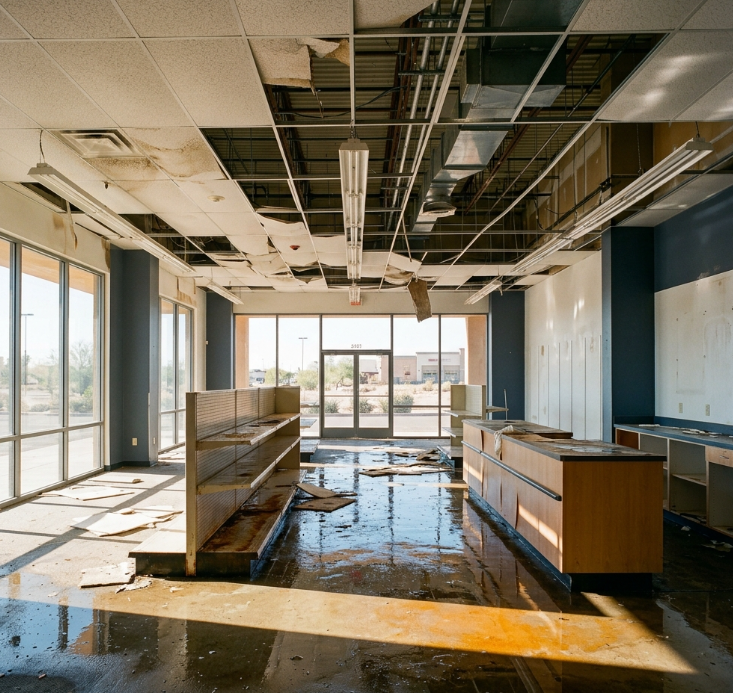
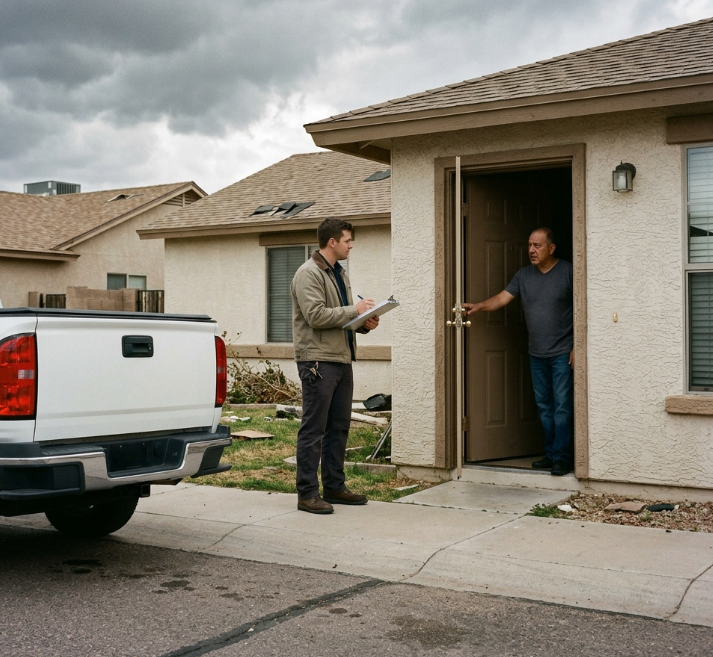
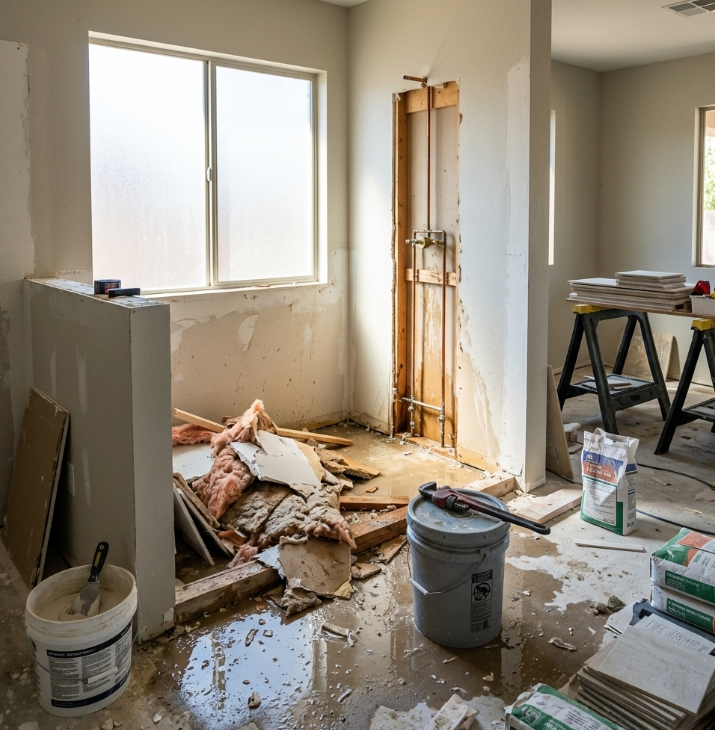
A pipe fails over a weekend in a leased office suite. Monday morning there's water across the floor, damaged drywall, and a tenant who can't open for business. The first question isn't how to fix it — it's who's responsible for fixing it. The landlord who owns the building? The tenant who leases the space?
In a commercial setting, the answer isn't found in general rules or who-caused-what intuition. It's found in the lease. And commercial leases divide property damage responsibility in ways that surprise both landlords and tenants who haven't read theirs closely since signing.
Here's how it actually works.
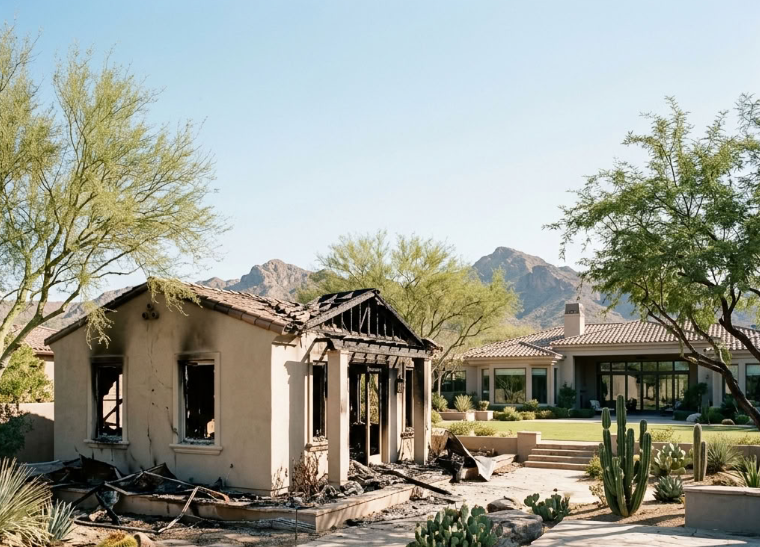
Water is the most common commercial loss, so it's the clearest example to work through — but the same responsibility framework applies whether the damage comes from fire, storm, vehicle impact, or any other covered peril. The lease governs regardless of cause.
The Lease Is the Authority
In residential rentals, there are baseline legal protections and fairly standardized expectations about landlord and tenant responsibility. Commercial leases are different. They're negotiated agreements between sophisticated parties, and courts generally enforce them as written. Whatever the lease says about property damage, restoration, and insurance is what governs.
This means there's no universal answer to commercial landlord-versus-tenant responsibility. There's what your specific lease says. Two businesses in the same building under different leases can have completely different responsibilities for the same type of loss.
The provisions that matter are the maintenance and repair clauses, the insurance requirements, the casualty and restoration clause, and any indemnification language. Most commercial tenants signed their lease focused on rent, term, and square footage — and never closely read the sections that determine what happens when the space is damaged. After a loss is the wrong time to read those sections for the first time.
The Lease Structure Drives Everything
Commercial leases fall into broad structures that shape how responsibility divides, and knowing which one you have tells you a lot.
Triple-net (NNN) leases push most property expenses onto the tenant — taxes, insurance, and maintenance. In a triple-net structure, tenants often carry significant responsibility for the condition of their space and sometimes for building systems serving it. The tenant may be responsible for restoring their own premises after a loss and for carrying the insurance that covers it.
Gross leases bundle most expenses into the rent, with the landlord retaining more responsibility for the building and its systems. Under a gross lease, the landlord typically carries more of the maintenance and restoration burden.
Modified gross and full-service leases sit between these, splitting responsibility in ways the specific lease defines.
Most commercial leases also draw a line similar to the condo walls-in/walls-out concept: the landlord is typically responsible for the building structure, roof, exterior, and common systems, while the tenant is responsible for their interior premises, their improvements, and their trade fixtures. But exactly where that line falls — and who restores what after a loss — is lease-specific.
The Casualty and Restoration Clause
The single most important provision for property damage is the casualty clause — sometimes called the damage and destruction or restoration clause. It governs what happens when the premises are damaged by a covered event.
A typical casualty clause addresses several things: who is obligated to restore the premises after a loss, what happens to rent during the restoration period, and under what circumstances either party can terminate the lease rather than rebuild.
The restoration obligation. The clause defines who rebuilds. Often the landlord restores the building structure and shell while the tenant restores their own improvements, fixtures, and interior buildout. But the specifics vary, and some leases put more of the restoration on one party than the other.
Rent abatement. Many casualty clauses provide for rent to be reduced or abated while the premises are unusable due to a covered loss. The extent of abatement — full or partial, and for how long — is defined in the clause. This matters enormously to a tenant who can't operate but is still on the hook for rent, and to a landlord whose income stream is interrupted.
Termination rights. Most casualty clauses give one or both parties the right to terminate the lease if the damage is severe enough — typically if restoration would take longer than a defined period, or if a certain percentage of the premises or building is destroyed. This is where a major loss can end a tenancy entirely rather than triggering a rebuild.
Who Carries Which Insurance
Commercial leases specify insurance obligations for both parties, and understanding the split is essential to knowing how a loss gets paid.
The landlord typically carries property insurance on the building — the structure, the shell, the common areas, and the building systems. This is what responds to structural damage from a covered loss.
The tenant typically carries several coverages: property insurance on their own improvements, betterments, trade fixtures, inventory, and equipment; business interruption or business income coverage to replace lost revenue during a closure; and commercial general liability coverage.
The tenant's improvements and betterments coverage is a frequent point of confusion. When a tenant builds out a space — installs their own flooring, lighting, fixtures, finishes — those improvements are usually the tenant's responsibility to insure and restore, even though they're physically part of the landlord's building. After a loss, the tenant's policy restores the buildout while the landlord's policy restores the base building. Getting this split wrong leaves a gap that surfaces at the worst time.
The Waiver of Subrogation — A Provision That Changes the Fault Analysis
Many commercial leases contain a mutual waiver of subrogation. This provision is worth understanding because it changes how fault works after a loss.
Normally, if one party's negligence causes a loss, the other party's insurer can pursue that negligent party to recover what it paid — subrogation. A waiver of subrogation in a lease means both parties agree to look to their own insurance for covered losses and waive the right to pursue each other, even when one party's negligence caused the damage.
The practical effect: in a building with a mutual waiver of subrogation, a tenant whose negligence causes a water loss may not face a subrogation claim from the landlord's insurer, because the lease waived that right. Each party's own insurance absorbs its own covered losses. This is a common and often-overlooked provision that significantly affects who ultimately bears the cost of a loss.
Business Interruption — The Tenant's Critical Coverage
For a commercial tenant, the property damage is often not the biggest financial exposure — the lost revenue is. A business that can't operate for two months during restoration loses two months of income, and that loss isn't covered by anyone's property insurance.
Business interruption coverage — carried by the tenant on their own policy — is what replaces that lost income during the restoration period. A tenant without adequate business interruption coverage who suffers a significant loss faces not just the cost of restoring their buildout but the far larger cost of being unable to operate while it happens.
The restoration timeline directly affects this exposure, which means the speed and management of the restoration matters to the tenant's bottom line in a way that goes well beyond the physical repair. A faster, well-documented restoration shortens the business interruption period and the income loss that comes with it.
How to Sort Responsibility When a Commercial Loss Happens
When a commercial space is damaged, work through it in this order:
Pull the lease immediately. The maintenance, insurance, casualty, and indemnification provisions define everyone's responsibility. Read them before assuming anything.
Identify the source and cause. Where the loss originated affects responsibility and any fault analysis — subject to whatever the lease's subrogation waiver says.
Notify the right parties. Typically both the landlord and the tenant notify their respective insurers, and the parties notify each other per the lease's notice requirements. Commercial leases often have specific notice provisions with deadlines.
Mitigate immediately regardless of the responsibility question. This is critical and the same principle that applies everywhere: do not let the landlord-tenant responsibility question delay mitigation. A loss that spreads while the parties sort out who pays becomes a bigger loss for whoever ends up responsible — and in a commercial setting, a longer closure means more lost revenue. Stabilize first, sort responsibility in parallel.
Document thoroughly. With two parties, two insurers, and potentially business interruption claims in play, documentation of cause, scope, and timeline is even more important than in a single-owner loss.
Why Commercial Restoration Requires a Contractor Who Understands the Structure
Commercial restoration involves coordination that single-owner residential work doesn't. The contractor may be working with the landlord, the tenant, two separate insurance carriers, a property manager, and sometimes a tenant's corporate facilities team — all on one loss, with a lease defining who's responsible for which portion of the work.
A restoration contractor experienced in commercial work understands this. They know how to scope a loss that divides between base building and tenant improvements, how to coordinate with multiple stakeholders and carriers simultaneously, how to document in a way that supports both property and business interruption claims, and how to move fast because they understand that in a commercial setting, every day of closure is lost revenue for the tenant and lost rent for the landlord.
A contractor who only does residential or single-owner work struggles with the coordination layer that commercial losses require — and that struggle costs time, which costs money for everyone with a stake in the outcome.
RCS Builders handles commercial restoration across Greater Phoenix — retail, office, industrial, multi-tenant, and mixed-use. We understand the lease-driven responsibility structure, the multi-party coordination a commercial loss requires, and the urgency that comes with a business that can't operate. If you're a commercial landlord, tenant, or property manager dealing with a loss,
call us at 480-204-9035 — we'll handle the restoration while the responsibility structure gets worked through, and we'll move fast because we know what every day of closure costs.
Related: