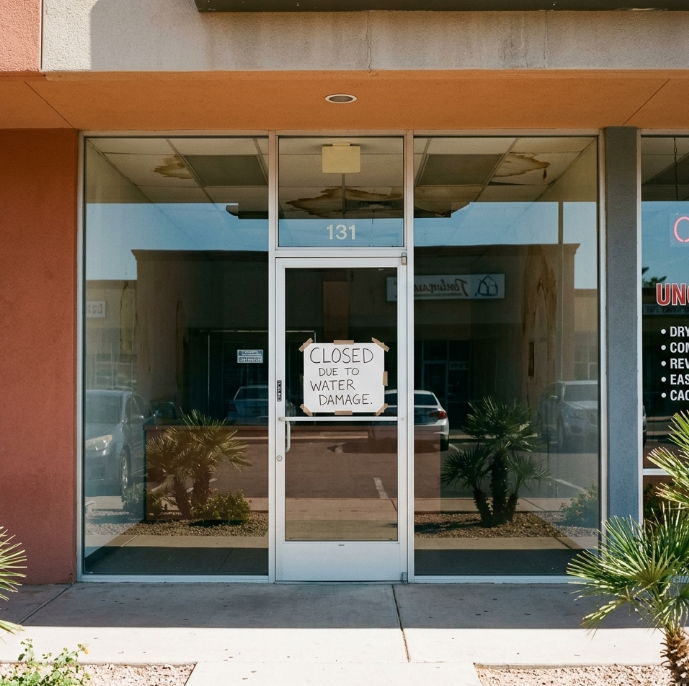
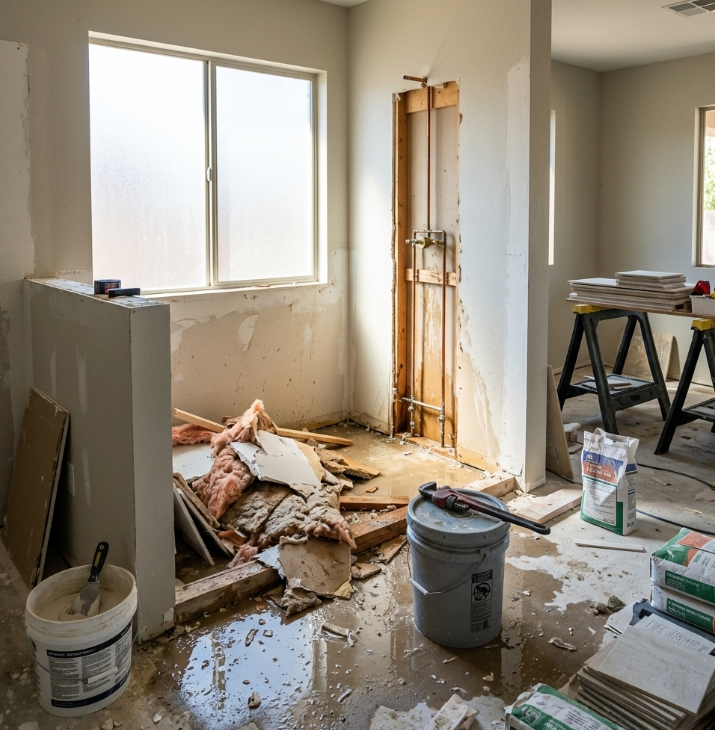
A pipe fails overnight in your Phoenix office. By morning there's standing water across two suites, the flooring is saturated, and the drywall is coming off the walls. You call your carrier, you file the claim, and somewhere in that conversation the term business interruption comes up.
Most commercial property owners nod along. They know they have it. They don't know what it actually does until they're trying to use it — and that's when the gap between what they expected and what the policy delivers becomes expensive.
Here's what business interruption coverage actually is, what it pays for, what it doesn't, and what determines whether your claim goes smoothly or sideways.
What Business Interruption Coverage Is
Business interruption insurance — sometimes called business income coverage — is designed to replace the income your business loses while your property is being restored after a covered loss. It's not a standalone policy in most cases. It's a coverage that rides alongside your commercial property policy and triggers when a covered peril causes physical damage that forces a full or partial shutdown.
The core concept is straightforward: if a fire, water event, storm, vehicle impact, or other structural or property damage event makes your property unusable and you lose revenue as a result, business interruption coverage steps in to replace what you would have earned during the restoration period.
In practice, the execution is more complicated than the concept.
What It Actually Pays For
Lost net income. The revenue your business would have generated during the restoration period minus the expenses you're no longer incurring because the business is closed or operating at reduced capacity. Not gross revenue — net income. The calculation matters and it's often a point of dispute between property owners and carriers.
Continuing fixed expenses. Expenses that continue regardless of whether your business is operating — rent or mortgage payments, loan obligations, insurance premiums, certain payroll costs for key employees you're retaining during the closure. These get covered because they represent real financial exposure that doesn't stop just because your doors are closed.
Extra expense coverage. Many business interruption policies include an extra expense component that covers costs you incur specifically to minimize the interruption — renting temporary space, leasing equipment, expediting material delivery to speed up the restoration. This coverage exists to incentivize property owners to get back to business faster rather than waiting out the full restoration period.
Payroll. Depending on your policy, payroll for employees you retain during the closure may be covered. This is particularly important for businesses where keeping key staff during a shutdown is critical to reopening successfully.
What It Doesn't Pay For
Losses not caused by physical damage. Business interruption coverage requires a covered physical loss to your property. If your business loses revenue because of a supply chain issue, a market downturn, a neighboring property's closure that affects your foot traffic, or any other cause that doesn't involve direct physical damage to your property — business interruption doesn't respond. This became a high-profile issue during pandemic-related closures and the courts have largely sided with carriers on the physical damage requirement.
Losses beyond the restoration period. Coverage applies during the period of restoration — the time it reasonably takes to repair or rebuild the damaged property. Once the property is restored to a condition where the business can operate, the coverage period ends. If your business takes longer to recover its pre-loss revenue after reopening, that extended recovery isn't covered.
Losses caused by excluded perils. If the underlying property damage was caused by something your policy excludes — flood without separate flood coverage, earthquake, certain water damage scenarios — the business interruption coverage doesn't trigger either. The BI coverage follows the property coverage. No covered property loss means no covered business interruption.
The waiting period. Most business interruption policies include a waiting period — typically 48 to 72 hours — before coverage begins. Losses incurred during that initial window aren't covered. On a short-duration loss this can represent a meaningful portion of the total interruption.
The Restoration Period Question
The restoration period is one of the most contested elements of business interruption claims and it's worth understanding before a loss occurs.
Your carrier's position on the restoration period is typically: how long would it reasonably take to restore the property with due diligence and dispatch. Not how long it actually takes. Not how long your contractor's schedule requires. How long it should take under a reasonable standard.
If your restoration takes longer than the carrier's estimate of reasonable — because of contractor scheduling, material availability, permitting delays, or any other factor — the carrier may argue the coverage period has ended even if your business is still not operational.
This creates a direct financial incentive to move the restoration as quickly as possible — and a direct financial consequence when restoration timelines extend for reasons outside the property owner's control. Permitting delays in certain Phoenix-area municipalities, material lead times on specialty items, trade scheduling in a busy market — all of these can push restoration timelines beyond what a carrier considers the reasonable restoration period.
Documentation of why the timeline is what it is — permits applied for on specific dates, material orders placed and lead times documented, contractor scheduling constraints recorded — gives you the basis for arguing that the restoration period should be extended to match the actual timeline.
How the Lost Income Calculation Works
This is where business interruption claims get technical and where property owners often leave money on the table.
Carriers calculate lost income by looking at your financial records — typically 12 months of prior revenue — and projecting what you would have earned during the restoration period based on historical performance. That projection is then adjusted for expenses you're not incurring during the closure.
The disputes arise around which expenses are truly variable — stopping when the business stops — and which are fixed obligations that continue regardless. Carriers sometimes characterize expenses as variable that a property owner considers fixed, which reduces the net income calculation and the resulting coverage.
Your financial documentation matters here. Clean, organized books that clearly show revenue by period, fixed vs. variable expense breakdown, and historical performance trends give you the strongest possible foundation for the income calculation. Businesses with messy or incomplete financials are at a disadvantage in this calculation — not because the carrier is acting in bad faith, but because the data needed to support the full claim isn't there.
The Extended Business Income Provision
Some business interruption policies include an extended business income provision — coverage that continues for a defined period after the property is restored because many businesses don't immediately return to pre-loss revenue levels after reopening.
Customers found alternatives during the closure. Staff turned over. Relationships lapsed. A restaurant that was closed for four months doesn't reopen to its pre-loss revenue on day one. The extended business income provision acknowledges this reality and provides a runway — typically 30 to 90 days beyond the restoration period — for the business to recover.
If your policy includes this provision, understand the trigger and the duration before a loss. It's one of the more valuable components of a comprehensive business interruption policy and one of the least understood.
What Landlords Need to Know
For landlords and property investors, the equivalent of business interruption coverage is rental income coverage — also called loss of rents coverage.
It works the same way: if a covered loss makes a rental unit uninhabitable and you lose rental income during the restoration period, loss of rents coverage replaces that income. The same restoration period logic applies — coverage runs until the property is restored to a habitable condition, not until you find a new tenant.
In the Phoenix market, where rental income properties represent a significant portion of the real estate landscape, loss of rents coverage is a critical component of a complete landlord policy. A multi-unit property where a water event takes out two units for 60 days represents real lost income — coverage that most landlords assume they have but don't always verify until they need it.
The Documentation That Drives the Claim
Business interruption claims live and die on documentation — more so than almost any other type of insurance claim because the loss is financial rather than physical and has to be calculated rather than observed.
What you need from the business side: prior year financial statements, monthly revenue records for at least 12 months before the loss, documentation of fixed expenses and ongoing obligations, records of any extra expenses incurred to minimize the interruption, and payroll records for the coverage period.
What you need from the restoration side: a clear timeline of when the loss occurred, when restoration began, what the scope of work is, when each phase of restoration is expected to be complete, and documentation of any delays and their causes. This is where your contractor's timeline management and documentation directly affects your business interruption claim — a contractor who can provide a detailed project schedule and document delays with specific causes gives you what you need to argue for an appropriate restoration period.
If You're Mid-Claim and the Numbers Don't Add Up
Business interruption claims are among the most frequently underpaid commercial insurance claims — not always through bad faith, but through the complexity of the calculation and the information asymmetry between carriers who do this daily and property owners who are doing it for the first time.
If your carrier's business interruption calculation feels light — if the restoration period seems too short, if the income calculation doesn't match your actual financials, if extra expenses aren't being credited — those are supplement and appeal conversations worth having.
RCS Builders works commercial restoration across Greater Phoenix and we understand how restoration timelines interact with business interruption claims. We document project schedules, track and record delays with their causes, and coordinate directly with carriers throughout the project. If you're dealing with a commercial loss and you want to make sure the restoration side of the job is supporting your business interruption claim properly,
call us at 480-204-9035.
Related: