Your carrier approved the claim. You just disagree — significantly — about what it's worth. Your contractor's estimate says the job costs $70,000. The carrier approved $40,000. The gap isn't a small rounding difference; it's a $30,000 chasm, and neither side is moving.
Most property owners in this situation think their only options are to accept the carrier's number or hire a lawyer and sue. There's a third path built into almost every property insurance policy that most people never learn about until someone tells them:
appraisal.
Here's how it works, when it makes sense, and what to know before you invoke it.
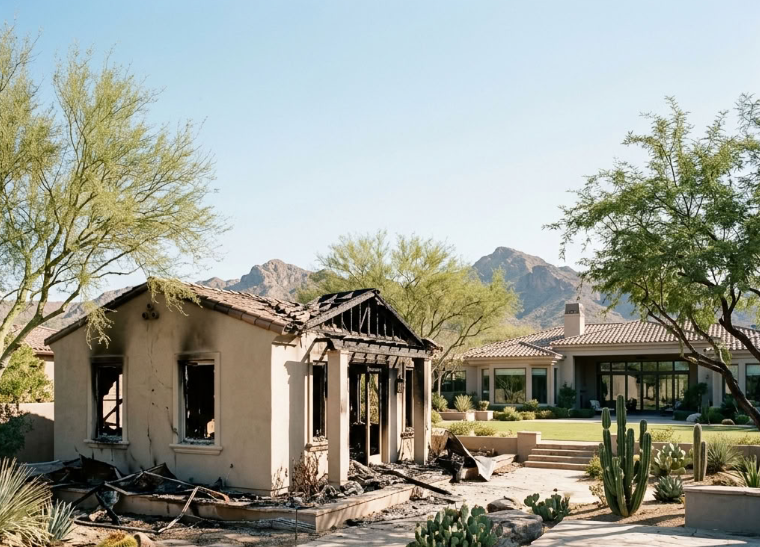
Water and fire losses generate the most valuation disputes because their scope is the hardest to pin down — so they're the clearest examples. But appraisal applies to any covered peril where you and the carrier disagree on the amount of the loss: storm, vehicle impact, structural, all of it.
What Appraisal Actually Is
Appraisal is a dispute resolution process written directly into your insurance policy. It exists specifically to resolve disagreements about the amount of a loss — how much the damage is worth — without litigation.
It's important to be precise about what appraisal resolves. It settles disputes over the amount of a covered loss.
It does not decide whether something is covered in the first place. If your carrier says "this damage isn't covered under your policy," that's a coverage dispute, and appraisal generally doesn't resolve it. But if your carrier agrees the damage is covered and you simply disagree about what it costs to fix, appraisal is the mechanism designed for exactly that.
Most property insurance policies in Arizona contain an appraisal clause. It's standard language, and either party — you or the carrier — can typically invoke it when there's a valuation dispute.
How the Process Works
The appraisal process follows a defined structure:
Either party demands appraisal. When there's a valuation dispute, either you or the carrier can invoke the appraisal clause, usually in writing. Once properly invoked, the process is generally binding under the policy terms.
Each side selects an independent appraiser. You choose and pay for your appraiser; the carrier chooses and pays for theirs. These appraisers are supposed to be independent and competent — people who understand construction costs and damage assessment. Your appraiser advocates for a fair, accurate valuation of the loss from your side.
The two appraisers select an umpire. Before or during the process, the two appraisers agree on a neutral third party — the umpire — who resolves any disagreement between them. If the two appraisers can't agree on an umpire, the policy usually provides a mechanism for one to be appointed, sometimes through a court.
The appraisers assess the loss. Each appraiser independently evaluates the damage and determines what they believe the loss is worth. They inspect, they review documentation, they price the scope.
Agreement or umpire decision. If the two appraisers agree on a value, that becomes the award. If they disagree, the disputed items go to the umpire. Typically, an agreement between any two of the three — the two appraisers, or one appraiser and the umpire — sets the binding award.
The award is binding. The appraisal award establishes the amount of the loss, and the carrier pays according to that award and your policy terms. It resolves the valuation dispute with finality.
When Appraisal Makes Sense
Appraisal is a tool for specific situations, not every disagreement. It makes the most sense when:
The dispute is about amount, not coverage. This is the threshold question. If the carrier agrees the loss is covered but you disagree on value, appraisal fits. If the fight is about whether it's covered at all, appraisal usually isn't the right tool.
The gap is significant enough to justify the process. Appraisal has costs — your appraiser's fee, your share of the umpire's fee, the time involved. On a $3,000 disagreement, those costs may eat the difference. On a $30,000 or $50,000 gap, appraisal is often well worth it.
Negotiation has stalled. Appraisal is generally a step you take after the normal back-and-forth — supplements, documentation, adjuster negotiation — has failed to close the gap. It's the escalation when reasonable efforts haven't resolved the dispute.
You have strong documentation supporting your number. Appraisal favors the side with better evidence. If your contractor's estimate is thorough, well-documented, and defensible, appraisal gives that evidence a neutral forum. If your number is thinly supported, appraisal is riskier.
When Appraisal Isn't the Right Tool
Appraisal has real limits worth understanding:
It doesn't resolve coverage disputes. Worth repeating because it's the most common misunderstanding. If the carrier denied coverage — said the peril is excluded, the damage is pre-existing, the claim isn't covered — that's a coverage question. Appraisal decides amount, not coverage. Coverage disputes go through appeals, the Department of Insurance, or litigation.
It doesn't address bad faith. If your carrier handled your claim in bad faith — unreasonable denial, failure to investigate, misrepresentation — that's a legal matter with its own remedies, not something appraisal resolves.
The award is binding, which cuts both ways. Appraisal can come back lower than you hoped. Once you invoke it and the award is set, you're generally bound by it. It's not a process to enter casually or without confidence in your position.
It has costs. Your appraiser, your share of the umpire, and the time. These are worth it on a large dispute and not worth it on a small one.
Choosing Your Appraiser Matters
The appraiser you select significantly affects the outcome. A strong appraiser understands construction and restoration costs, knows how to document and defend a valuation, and has the credibility to work effectively with the other appraiser and the umpire.
Look for someone experienced specifically in property damage appraisal — ideally someone who knows the type of loss involved and the local Greater Phoenix cost environment. An appraiser who understands Valley construction costs, local material and labor pricing, and the specific damage patterns of this market brings more credibility to your valuation than someone working from generic assumptions.
Your restoration contractor can often be a valuable resource here — both in providing the documented, defensible estimate that supports your position and sometimes in recommending qualified appraisers they've worked with.
How Your Contractor's Work Affects an Appraisal
This connects back to something that runs through every part of the claims process:
documentation determines outcomes.
An appraisal is fundamentally a contest of evidence and expertise. The side with the more thorough, better-documented, more defensible position tends to prevail. This means the quality of your contractor's original estimate and documentation directly affects how an appraisal goes.
A contractor who wrote a detailed Xactimate estimate, documented the full scope of damage thoroughly, photographed everything, and built a defensible case for the cost has given you the foundation for a strong appraisal position. A contractor who wrote a thin estimate with poor documentation has left you trying to defend a number that isn't well supported.
This is one more reason the contractor you choose at the beginning of a claim matters at every later stage. The documentation they build in the first days of the job is the same evidence that supports a supplement, an appeal, or — if it comes to it — an appraisal months later.
The Bottom Line
When you and your carrier genuinely disagree about what a covered loss is worth, you're not stuck choosing between accepting a low number and hiring a lawyer. Appraisal is a built-in process designed to resolve valuation disputes with a neutral, binding decision — often faster and less expensively than litigation.
It's the right tool when the dispute is about amount rather than coverage, when the gap is large enough to justify the process, and when you have strong documentation supporting your position. It's not the right tool for coverage disputes or bad faith claims, and it's binding, so it's a step to take with confidence rather than casually.
RCS Builders writes thorough, defensible Xactimate estimates and documents every job completely — which is exactly the foundation a strong appraisal position requires. If you're in a valuation dispute with your carrier and wondering whether appraisal makes sense for your situation,
call us at 480-204-9035. We'll give you an honest read on whether your documentation supports the process and what your options look like.
Related: