Commercial Storm Restoration and Reconstruction in Chandler, AZ: What Business Owners Need to Know
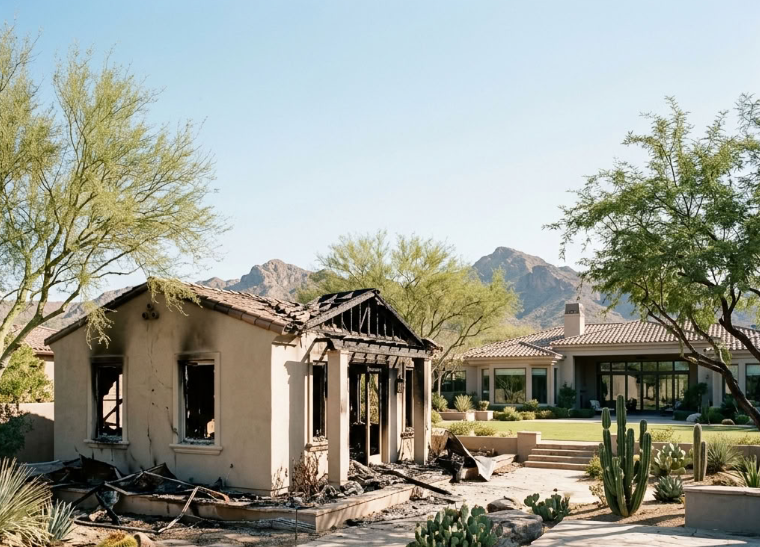
A licensed general contractor who handles both mitigation and structural rebuild is the single most important decision a Chandler business owner makes after storm damage — because Chandler's flat urban topography causes flash flooding to pool at ground-floor entries and parking lots faster than a mitigation-only company can respond with just water extraction equipment. When a microburst tears through a commercial corridor along Price Road or Chandler Blvd, the damage doesn't stop at wet floors; it includes blown roof membranes, cladding failures, and compromised framing that require permitted reconstruction, not just drying.
How Does Chandler's Monsoon Season Affect Commercial Buildings?
Monsoon season officially runs June 15 through September 30 in the Chandler area, with residual storm activity extending into early fall — meaning many business owners face damage right when they least expect the season to continue.
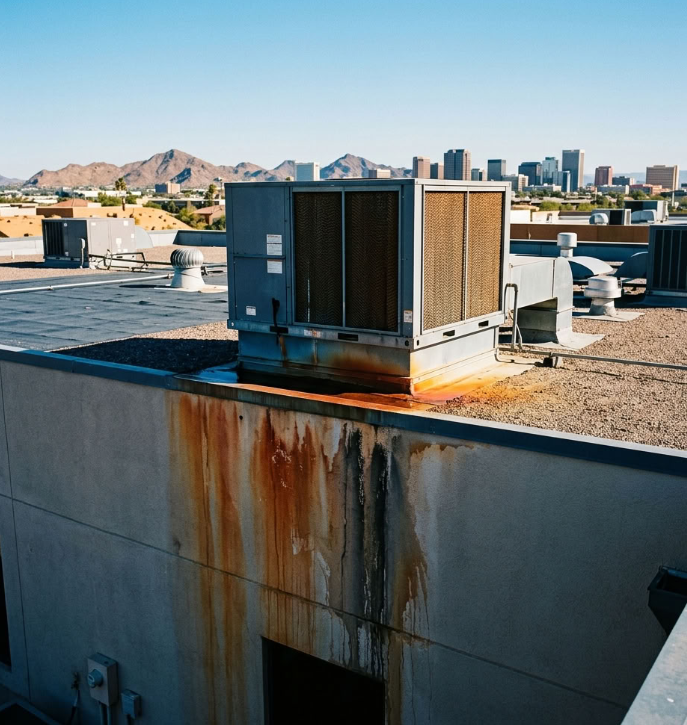
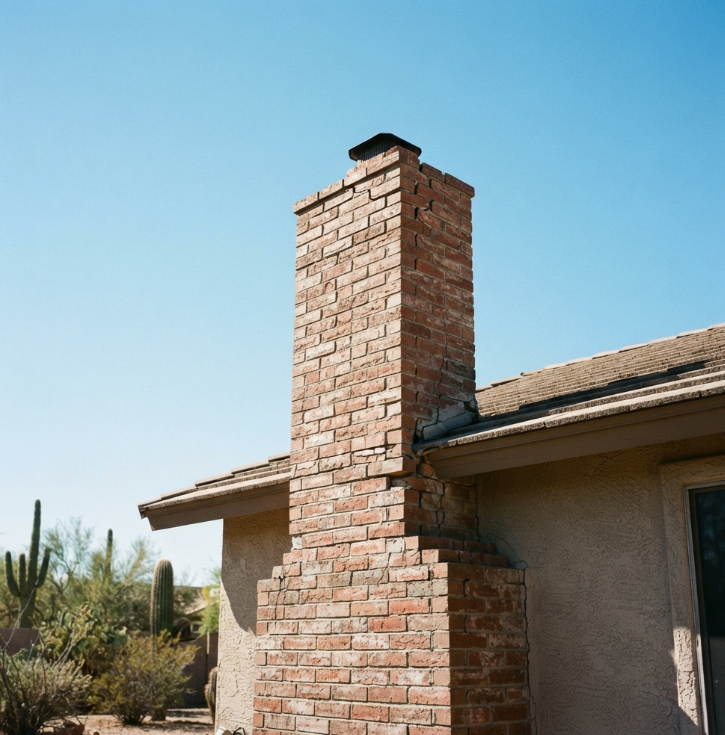
Three storm types create distinct commercial risks. Haboobs force fine dust into HVAC intakes and drainage systems, accelerating equipment wear. Microburst winds reaching 80–100 mph can strip roof membranes, collapse canopies, and send wind-driven signage through storefront glazing. Heavy rain and hail puncture flat commercial roof systems, allowing water to travel deep into wall cavities before anyone notices interior damage.
Strip centers, light industrial buildings, and Class A/B office parks along the Loop 202 and Price/101 tech corridor are especially exposed because large roof spans and wide facade openings create more surface area for wind and water to breach.
What Does Full-Cycle Commercial Storm Restoration Actually Include?
A complete commercial storm response moves through six distinct phases, and each one must connect to the next without gaps — otherwise, delays compound and business downtime stretches unnecessarily.
Emergency response (0–24 hours): This means site security, emergency board-up, tarping over breached roof sections, and water extraction to stop active intrusion. Stopping water movement immediately limits secondary damage like mold growth inside wall and ceiling cavities.
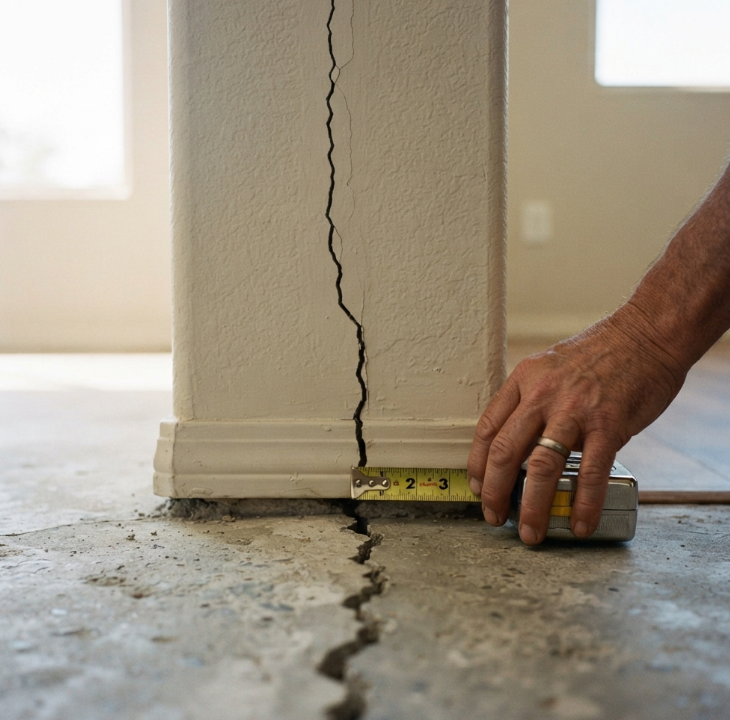
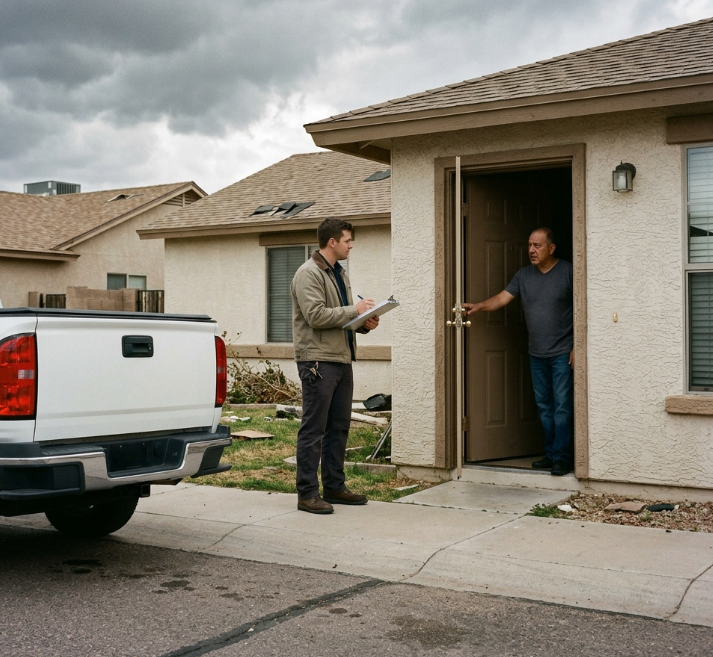
Damage assessment and documentation: A licensed contractor photographs and scopes the full extent of structural and moisture damage before any debris is removed. Insurance adjusters need this pre-mitigation evidence to validate a commercial claim; removing debris first can cause coverage disputes.
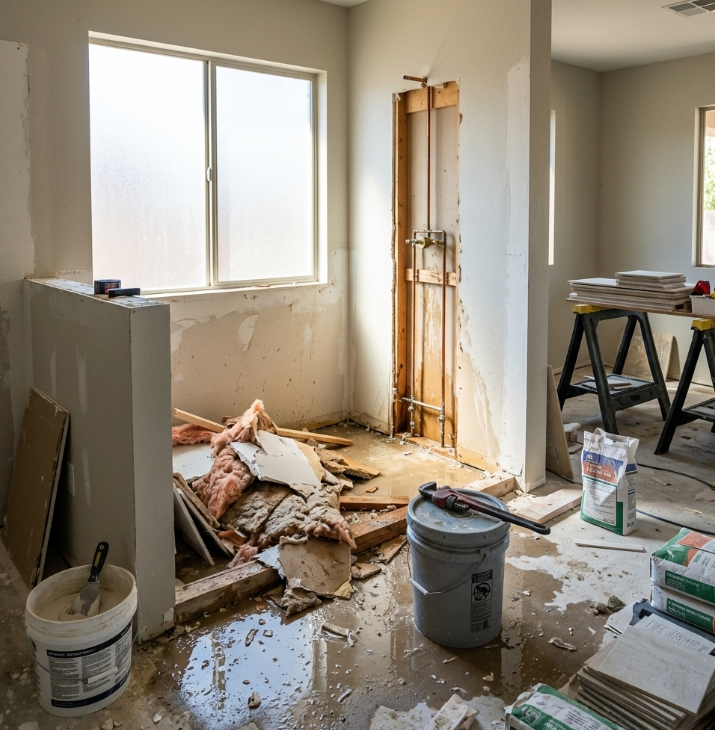
Controlled demolition: This is precision removal of only the structurally compromised sections — a damaged roof bay, a failed exterior wall section, or a water-saturated ceiling assembly — while preserving the salvageable structure around it. It is not indiscriminate teardown, and it requires a licensed contractor to execute safely. For more on how water damage restoration intersects with structural exposure, the same documentation principles apply whether damage originates from storm intrusion or internal sources.
Structural drying and mitigation: IICRC-standard drying (using Industrial dehumidifiers and airmovers certified under Water Restoration Technician and Applied Structural Drying protocols) removes moisture from commercial cavities that basic fans cannot reach. This step prevents mold from forming inside wall assemblies where it is expensive to remediate later.
Permitted reconstruction: A licensed general contractor pulls the required Maricopa County building permits, coordinates roofing, framing, mechanical, electrical, and plumbing trades, and manages inspections to International Building Code (IBC) standards. Unpermitted work on a commercial structure can void insurance coverage and create liability exposure for the property owner.
Final inspection and reopening: The building receives a certificate of re-occupancy sign-off, and the business reopens with documentation that all structural work passed inspection.
Can One Contractor Handle Both Mitigation and Reconstruction?
Yes — and for commercial storm work, a single contractor holding both mitigation scope and a general contracting license is significantly faster and more reliable than coordinating two separate vendors.
When a mitigation company finishes drying and hands off to a separate GC, the two parties often dispute scope boundaries: whose responsibility is the damaged framing that was uncovered during drying? Who documents it for the insurance adjuster? These handoff gaps cause claim delays and extended business closure.
A contractor licensed by the Arizona Registrar of Contractors (ROC) — the state body that governs any structural work over $1,000 — and also holding IICRC certification for mitigation can manage a unified scope of work from day one. That unified scope produces a single set of insurance documentation, aligns with the adjuster's Xactimate-style commercial estimate, and eliminates the finger-pointing that slows reopening.
Keeping Your Business Operating During Storm Repairs
Phased reconstruction sequences work so that undamaged portions of a building remain open while damaged sections are rebuilt — reducing lost revenue significantly compared to a full-building closure.
For example, a strip center with storm damage confined to one unit can have demolition, drying, and rebuild scoped exclusively to that bay while adjacent tenants keep operating. Temporary walls and weatherproof enclosures separate the construction zone from operating areas, blocking construction dust and preventing weather intrusion into the active business space.
Scheduling noisy demo and heavy trades around business operating hours — early morning or after closing — reduces disruption to staff and customers. The cause-and-effect is direct: the tighter the phasing plan, the shorter the period of lost revenue for each tenant or department.
Navigating Commercial Insurance Documentation After a Storm
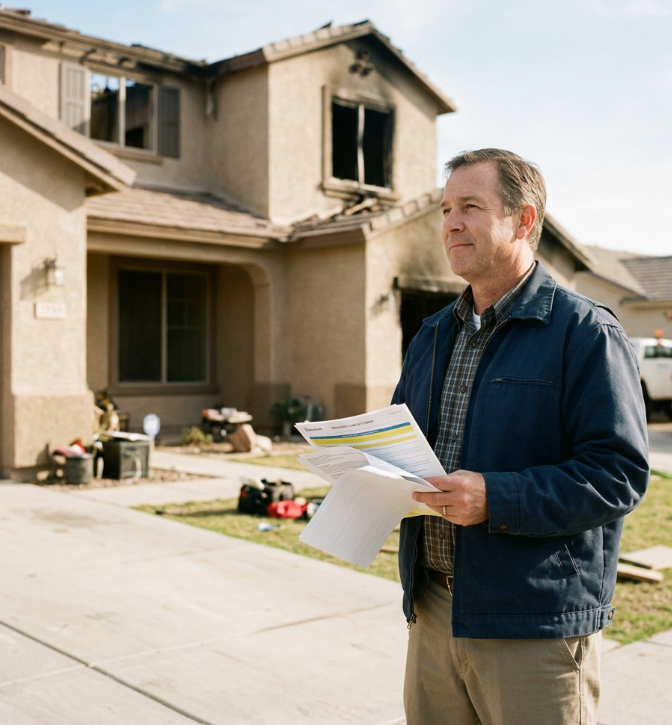
Commercial storm claims are larger and more detailed than residential ones, and they require itemized scoping — often in Xactimate format, which is industry-standard estimating software that adjusters use to validate line-item costs. A GC who scopes in the same format reduces back-and-forth with the adjuster and speeds up claim approval.
Business interruption (BI) documentation ties directly to the reconstruction timeline: the faster the certified contractor can produce a schedule, the sooner the BI calculation is grounded in a real reopening date, which protects the property owner's claim for lost income.
Storm Restoration Across the East Valley and Greater Phoenix
Chandler commercial properties sit within a broader network of storm-exposed corridors across the East Valley and Greater Phoenix. The same monsoon systems that hit Chandler move across the region, affecting commercial districts from the West Valley through the Scottsdale area. Businesses needing storm restoration services in the greater Scottsdale and Carefree area face similar microburst and flash-flooding risks that demand the same full-cycle response approach.
A contractor with verified ROC licensing, IICRC certification, and commercial GC scope is the combination that protects a Chandler property owner from unlicensed work disputes, incomplete insurance documentation, and extended downtime. Phased repairs tied to a real construction schedule mean the business reopens sooner — and the documentation produced along the way supports every layer of the insurance claim.
Schedule your post-storm damage assessment with RCS Builders LLC to put a licensed, full-cycle commercial restoration team on your Chandler property from day one.