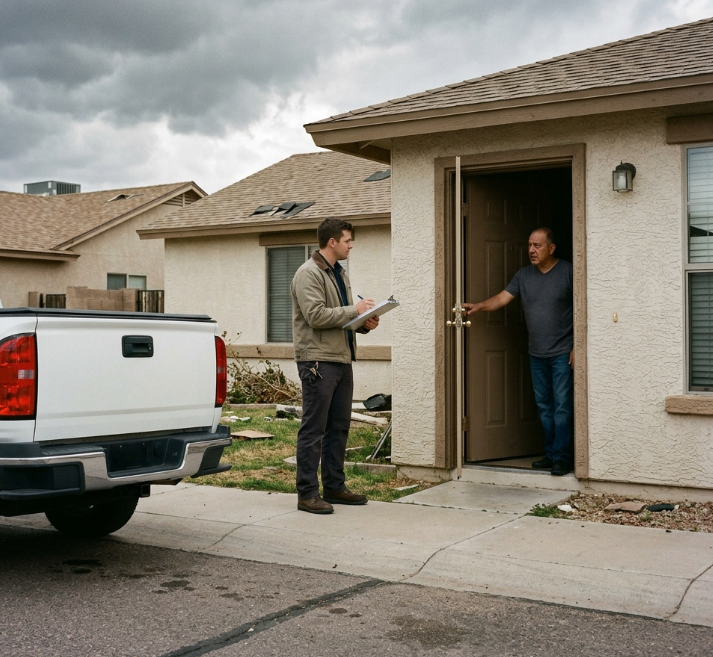
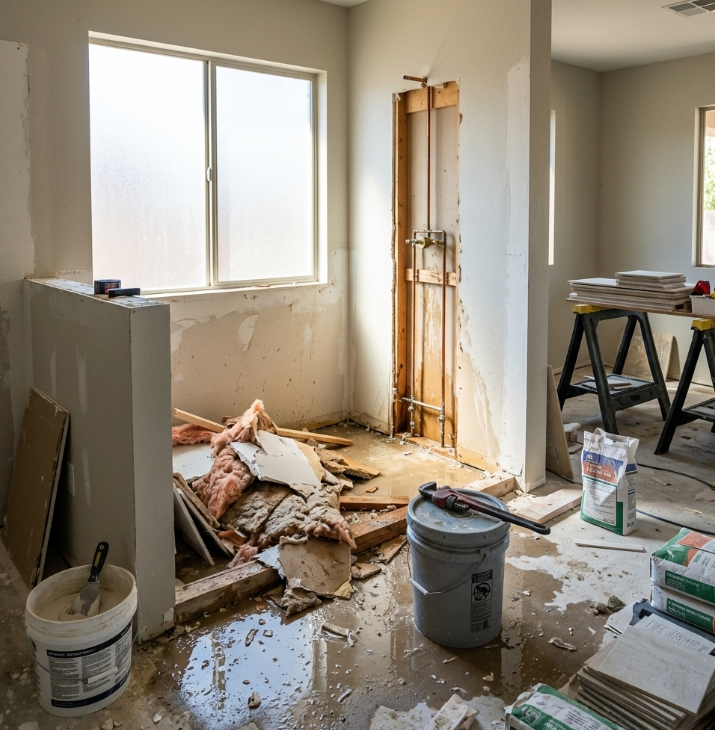
Swamp coolers — evaporative coolers — are still everywhere across Greater Phoenix. In homes, especially older properties, garages, and mobile homes. And just as much, if not more, in commercial and industrial buildings — warehouses, manufacturing floors, auto shops, workshops, restaurant back-of-house areas, and event spaces, where evaporative cooling is often the practical, cost-effective choice for cooling large open square footage in dry heat.
They're simple, efficient, and cheap to run compared to refrigerated AC at scale. They're also, mechanically, a water appliance sitting on a roof or wall, actively circulating and evaporating water all day during the cooling season — which means they fail in ways a standard refrigerated AC system never does, and the resulting water damage often catches property owners off guard, whether it's a home or a commercial building.
Here's how swamp coolers actually fail, why the damage is frequently worse than expected in both residential and commercial settings, and what to do about it.
Why a Swamp Cooler Is a Different Kind of Risk Than Central AC
A refrigerated air conditioner produces condensate — a byproduct of cooling — that's supposed to drain away in small, controlled amounts. When that drain line clogs, you get an overflow, which is a real problem, but it's a secondary consequence of the system's normal operation.
A swamp cooler works completely differently, and the difference matters. It has a water reservoir, typically fed by a dedicated supply line with a float valve, similar to a toilet tank. A pump circulates that water continuously over cooling pads while a fan draws air through them, and the evaporation process is what cools the air. This means a swamp cooler is actively holding and circulating a supply of water throughout the entire time it's running — not incidentally producing a small amount of condensate, but functioning as a wet system by design.
That distinction is exactly why swamp cooler failures tend to release more water, more suddenly, than a typical AC condensate issue. When something goes wrong with the water supply, the float valve, or the reservoir, you're not dealing with an overflow of a drip pan — you're dealing with a supply line failure or reservoir malfunction that can release water continuously until someone notices and shuts it off.
Residential Swamp Coolers: Where They're Located and Why It Matters
Most residential swamp coolers are roof-mounted, sitting directly above the living space they cool, with a water supply line running up through the roof or an exterior wall. Some are mounted on window frames or exterior walls at ground level, common on garages, workshops, and older or mobile homes.
The roof-mounted placement is what makes residential swamp cooler leaks so damaging. A failure at this location doesn't just create a wet spot — it introduces water directly into the roof penetration, the surrounding roofing material, the attic space below, and potentially the ceiling and walls beneath that. It behaves less like an appliance leak and more like a roof leak, because that's functionally what it is: water entering the structure at a roof penetration point and traveling downward through insulation, framing, and ceiling materials before it's ever noticed.
Commercial and Industrial Swamp Coolers: A Bigger System, a Bigger Failure
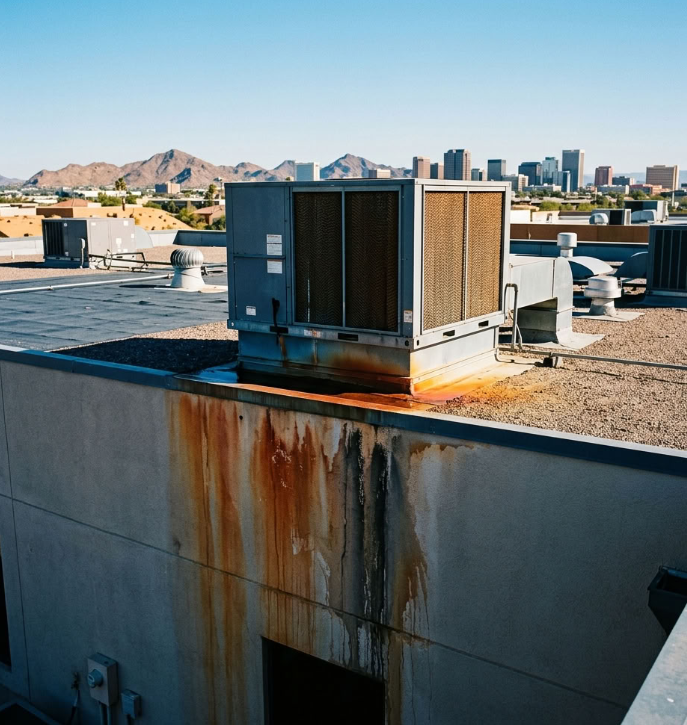
Commercial evaporative cooling is often a different scale entirely — larger rooftop units, sometimes multiple units serving different zones of a building, and in many industrial and warehouse settings, ducted systems distributing cooled air across a large open floor plan.
That scale changes the risk profile. A commercial-grade swamp cooler holds and circulates significantly more water than a residential unit, which means a float valve or supply line failure at commercial scale can release water at a volume and rate that a residential failure never approaches. On a large flat commercial roof, that water doesn't always show up quickly as an obvious leak — it can pool, find a low point, or travel along the roof membrane and enter the building at a completely different location than the unit itself, making the source harder to trace without a proper roof inspection.
Commercial and industrial buildings also tend to run swamp coolers longer and harder — cooling large spaces for extended operating hours — which means more cumulative wear on pumps, float valves, and connections, and less downtime for the kind of routine inspection a homeowner might do on a residential unit before flipping it on for the season.
And in commercial settings, the stakes of a slow leak are often higher: water intrusion above inventory, equipment, server or electrical rooms, or finished retail and office space below can mean damage well beyond the building itself — product loss, equipment damage, and business interruption on top of the structural repair.
The Most Common Ways Swamp Coolers Fail — Residential and Commercial
Float valve failure. The float valve controls water level in the reservoir, the same way a toilet's float controls tank level. When it fails — sticking open, wearing out, or malfunctioning — water keeps flowing past the point where it should shut off, and the unit overflows. This can continue for hours or days if not caught, especially when a unit that sat dormant all winter is switched back on without a full inspection — a risk that applies equally to a home unit and a large commercial rooftop system.
Supply line failure. The water line feeding the cooler — often exposed to sun exposure and temperature swings — can crack, split, or disconnect at the connection point, releasing water continuously until the supply is shut off. On commercial systems with longer supply runs and larger connections, a failure here can release significantly more water before it's noticed.
Reservoir and pan corrosion or cracking. Reservoirs and drain pans corrode or crack over years of constant water exposure and Phoenix's intense sun. This applies to both residential units and the larger pans on commercial rooftop systems.
Overflow or bleed-off drain line issues. Swamp coolers use a bleed-off system to periodically drain mineral-laden water and prevent scale buildup. If this drain line is clogged, disconnected, or improperly routed, that discharge water ends up somewhere it shouldn't — a bigger problem on a large commercial roof with multiple units and drain lines to manage.
Seasonal neglect. Swamp coolers sit unused for months during the off-season, and units that aren't inspected, drained, or serviced before winter and before summer startup fail at a much higher rate. This is true whether it's a single residential unit or a bank of units on a commercial roof — and on a commercial property, a startup inspection missed across multiple units multiplies the risk.
Why the Resulting Damage Is Often More Extensive Than People Expect
Because most swamp coolers sit on the roof directly above the space they cool, and because their failures tend to release sustained volumes of water rather than a small drip, the resulting damage pattern is often more extensive than property owners anticipate — in a home or a commercial building.
Water entering at a roof penetration travels along roof decking and into insulation before it ever shows as a visible stain below — by the time you see it, the surrounding area is typically already saturated well beyond the visible mark. On a commercial flat roof, water can travel even further laterally before finding its way in, which means the visible damage point and the actual source can be in completely different locations. If the leak has gone unnoticed for any length of time, that saturated material is already a candidate for mold growth — and in Phoenix's summer heat, that clock runs in as little as 24 hours, regardless of whether it's a home ceiling or a commercial drop ceiling over retail floor space.
Because swamp cooler season overlaps with the hottest part of the year, a leak often goes undetected longer than it would otherwise — homeowners are focused on staying cool, and commercial facilities teams are often managing a much longer list of building systems, which means a slow leak on a rooftop unit can run for an extended period before anyone traces the source.
What to Do If You Suspect a Swamp Cooler Leak
Shut off the water supply to the unit immediately. Locate the shutoff valve on the supply line and turn it off — the same first step whether it's a single residential unit or one of several commercial rooftop systems.
Don't run the unit until it's inspected. Continuing to run it feeds more water into the problem.
Check the space below the unit for staining, sagging, or moisture. In a home, that's the attic and ceiling. In a commercial building, that's the ceiling grid, any drop ceiling, and the roof deck itself — and on a larger commercial roof, checking the full roof surface for pooling or membrane damage near every unit, not just the one you suspect.
Document what you find before touching anything. Photograph any staining, sagging materials, or visible water — this matters for an insurance claim, whether it's a homeowner's policy or a commercial property policy.
Get the affected area professionally assessed. Given how far swamp cooler leaks often travel before they're discovered, and how quickly Phoenix heat turns hidden moisture into mold, a professional assessment — including moisture mapping — is the right move rather than assuming a visible stain represents the whole problem. This matters even more on a commercial roof, where multiple units and a large surface area make it harder to trace a leak by sight alone.
The Insurance Angle
Swamp cooler water damage is generally treated the same way other system failures are treated: sudden, accidental failures are typically covered under a standard homeowner's or commercial property policy, while damage from a slow leak that went on for an extended period due to lack of maintenance can be characterized as a maintenance issue rather than a covered loss.
Given that swamp coolers often sit unused and uninspected for months, and failures are frequently discovered at seasonal startup, the cause and timeline matter for how a claim gets evaluated. On commercial claims specifically, business interruption and damage to inventory, equipment, or tenant improvements can be part of the loss alongside the structural repair — which makes thorough documentation of the failure point and the damage pattern even more important to a complete, properly valued claim.
Why This Requires the Same Response as Any Roof-Level Water Intrusion
Because a rooftop swamp cooler failure functions like a roof leak — introducing water at a roof penetration and letting it travel through insulation, framing, and ceiling materials — it needs the same seriousness and the same moisture-mapping approach as any other roof-level water intrusion, whether it's affecting a single home or a large commercial building.
RCS Builders handles water damage from swamp cooler failures across Greater Phoenix, residential and commercial — moisture mapping to find the full extent of travel across roofing, insulation, and interior systems, structural drying, and complete repair of any affected areas. For commercial properties, we also document business interruption and equipment or inventory impact as part of a complete claim. If you've found evidence of a swamp cooler leak or you're not sure how far the water has traveled,
call us at 480-204-9035. We'll assess the full extent — not just what's visible — and get it dried and repaired properly.
Related: